Running a practice
A functional medicine practice management guide to cutting admin and charting time per patient, and how Cerbo, Practice Better, CharmHealth and Cliniko fit.
James Marin, RD, EN10 min read

In this article9 sectionsClose
- Key takeaways
- How can a small functional medicine clinic reduce admin and charting time per patient?
- Where does charting time actually go during a functional medicine visit?
- Why does this have to be a practice-management fix, not a personal habit?
- How does AI documentation cut charting time without flattening a clinician's own protocol template?
- What does each EMR connection actually do: Cerbo, Practice Better, CharmHealth and Cliniko?
- What does this actually cost across a whole functional medicine team?
- How do you roll this out without disrupting patients mid-protocol?
- Frequently asked questions
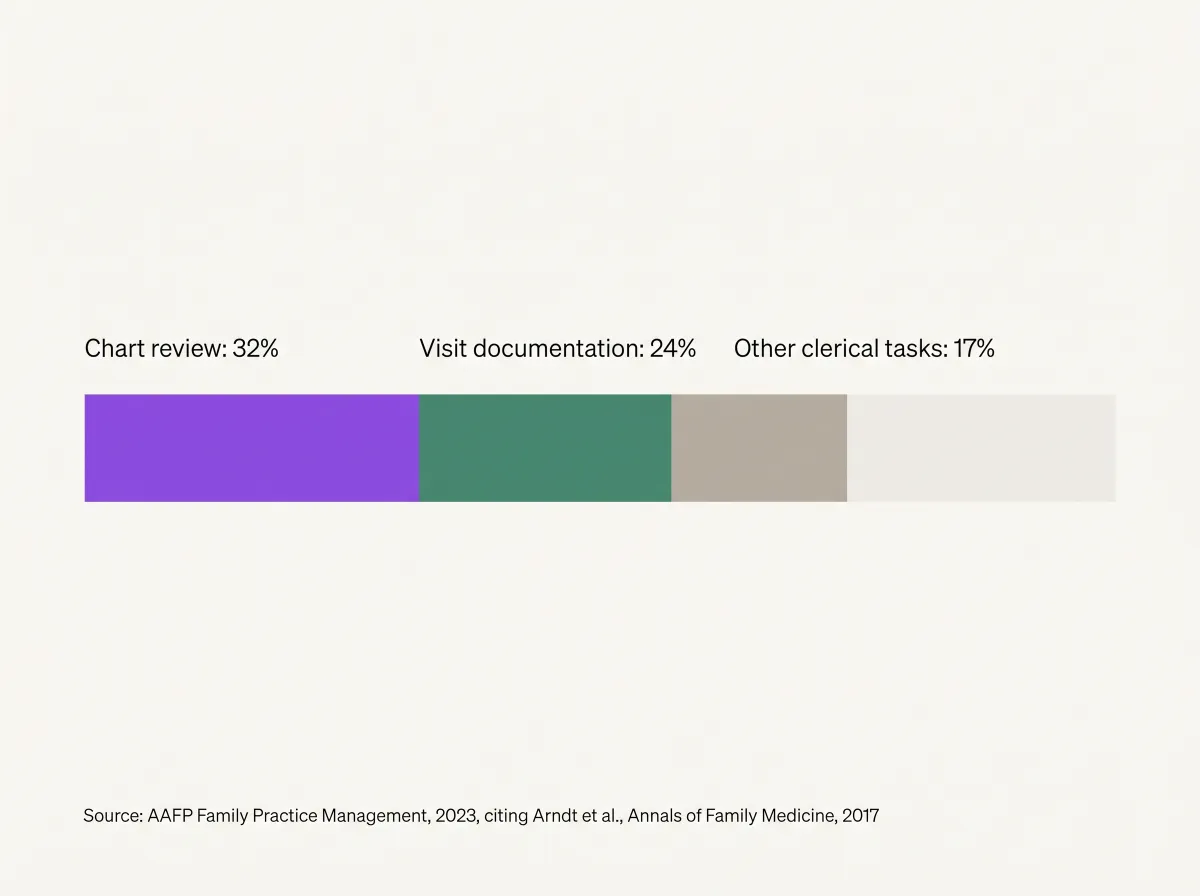
A ten-patient day usually costs a functional medicine practice more admin time than the same day costs a standard primary care office. The intake runs longer, the chart carries a GI-MAP or a DUTCH panel most EMRs were never built to parse, and the note has to hold a protocol, not just a diagnosis code. Functional medicine practice management has to solve for that directly. Family physicians already lose over half the workday to the EHR, split across chart review, documentation and clerical tasks (AAFP, Family Practice Management, 2023, citing Arndt et al., Annals of Family Medicine, 2017). A functional medicine visit adds genomics, lab panels and protocol notes on top of that baseline.
This piece is for the person who owns that problem for the whole clinic, not just their own calendar. It covers where the time goes, what changes when the fix runs at the practice level instead of the desk level, and what it costs to put a whole team, not one keen early adopter, on a single documentation workflow.
Key takeaways
| Point | Details |
|---|---|
| Admin eats roughly half the clinic day | Family physicians spend over 50% of the workday in the EHR, split into chart review (32%), visit documentation (24%) and other clerical tasks (17%) (AAFP, FPM, 2023, citing Arndt et al., 2017) |
| Controlled studies back the category, with limits | A 2026 multisite study of 8,581 clinicians found AI scribe adoption cut documentation time by 16 minutes per 8 scheduled patient hours, about a 10% relative drop (JAMA, Rotenstein et al., 2026) |
| Results depend on the tool, not just the category | A UCLA randomized trial found one ambient scribe cut time-in-note by 9.5%, while a second scribe in the same trial showed no significant change (NEJM AI, Lukac et al., 2025) |
| The fix has to work at the practice level | One documentation workflow across a physician, nurse practitioners, a dietitian and coaches recovers time at every seat, instead of depending on one person's discipline |
| EMR connections differ by platform | Cerbo and CharmHealth get the finished note back on a click after review. Cliniko takes a treatment note where that is switched on per practice. With Practice Better, Ena pulls client data, labs and intake forms in, and the clinician copies the reviewed draft into the client record |
| Team pricing is quoted, not multiplied | Clinician seats are $79 per seat per month ($790 per year). Practice and Enterprise plans are priced on team size and requirements |
How can a small functional medicine clinic reduce admin and charting time per patient?
A small functional medicine clinic cuts admin and charting time per patient by moving documentation into the visit itself. Record the consult, draft the note and care plan from that recording in the clinician's own template, review it, and get it into the EMR the practice already runs. The saving only holds at the practice level once every role on the team works from that same workflow, not just the lead physician.
That is the mechanism in one paragraph. The rest of this piece is about making it stick once a second clinician, a third, and eventually a dietitian and a coach are all touching the same patient record.
Where does charting time actually go during a functional medicine visit?
Most of the time disappears before a clinician writes a word of the day's note, into chart review ahead of the visit. Family medicine data summarized in AAFP's Family Practice Management breaks administrative and EHR time into chart review (32%), visit documentation (24%) and other clerical tasks like order entry (17%), on top of inbox management that runs close to a quarter of total EHR time on its own.
A functional medicine intake stretches that further. A new patient often means reconciling a GI-MAP, a DUTCH panel and two years of prior labs before the physician and the patient are in the room together. So the chart review share of the day is usually larger here than the family medicine baseline above, before a word of the visit note gets written.
Why does this have to be a practice-management fix, not a personal habit?
A faster personal habit only saves time for the one person who adopts it, and a functional medicine team rarely runs on one person's calendar for long. Dr. Craig Tanio of Rezilir Health put it plainly: "Our visits are the most documentation-heavy in medicine. Genomics, brain imaging, panels most doctors never order." At Rezilir, a physician, two nurse practitioners, a dietitian and coaches can all touch one patient, and the whole care team works from one current record instead of five separate habits.
That is what functional medicine practice management actually describes: the point where admin time stops being an individual complaint and becomes a line item a practice owner can plan against. Cost per seat, time recovered per clinician, and whether documentation turnaround holds up as the team grows past two or three people. A shared workflow also makes handoffs between roles faster, since a dietitian picking up a physician's note does not have to decode a format unique to that one clinician.
How does AI documentation cut charting time without flattening a clinician's own protocol template?
It works when it drafts in that clinician's own format instead of forcing every provider into one fixed structure. Ena records the consultation from computer audio, with no meeting bot joining the call, and drafts the note, care plan and any meal plan in SOAP, DAP, PIE, BIRP, narrative or a fully custom format that matches how that clinician already writes. See the AI medical scribe use case for how the recording and drafting step works end to end.
Dr. Seth Osgood of GrassRoots Functional Medicine described the difference this way: "It writes in my structure, not a template's." (case study). That matters more in functional medicine than in most of primary care, because a Bredesen protocol note, a Shoemaker CIRS workup and a Wahls protocol follow-up do not share a shape. A tool that forces them into one costs a clinician the rewrite time it was supposed to save.
The research backs the category, with real variation by tool. A 2026 multisite cohort study of 8,581 ambulatory clinicians found AI scribe adoption cut total EHR time by 13.4 minutes and documentation time by 16.0 minutes per 8 scheduled patient hours, with primary care clinicians seeing a 26.9-minute drop (JAMA, Rotenstein et al., 2026). A Stanford quality improvement study of 45 physicians across 8 specialties found median daily documentation time down 6.89 minutes and total EHR time down 19.95 minutes once a scribe was in regular use (JAMIA, Ma et al., 2024). But a UCLA randomized trial of 238 physicians found the effect depends on which tool: one ambient scribe cut time-in-note by 9.5%, while a second showed no statistically significant change (NEJM AI, Lukac et al., 2025). A transcript-only tool with no chart pull and no protocol awareness is not interchangeable with one built around the EMR and the clinician's own template.
| Approach | Documentation speed | Protocol template fidelity | Team-wide rollout |
|---|---|---|---|
| Manual charting | Slowest; most after-hours work | Full clinician control, inconsistent across the team | No standardization |
| Generic transcript-only AI scribe | Faster than manual, but varies by tool | Fixed or generic templates; no EMR chart pull | Each clinician configures separately |
| EMR-connected documentation workflow | Draft ready when the visit ends, then reviewed | Matches each clinician's own template | One shared workflow and template library |
What does each EMR connection actually do: Cerbo, Practice Better, CharmHealth and Cliniko?
It depends on the platform, and a practice running more than one of them needs to know the difference before it promises patients a same-visit turnaround. Ena connects with Cerbo, Practice Better, CharmHealth and Cliniko (switched on per practice). The draft starts from the real chart, not a blank page. What happens after the draft is where they differ:
- Cerbo and CharmHealth: the finished note or care plan goes back to the chart on a click once the clinician has reviewed it, not automatically.
- Cliniko: Ena sends a treatment note, draft or final, once that is switched on for the practice.
- Practice Better: one-way. Ena pulls client data, labs and intake forms in, and the clinician copies the reviewed draft into the client's record. The last step stays manual, but the blank-page problem is gone.
"We sell a written, data-driven plan and direct access. That falls apart if I am typing workups at night. [...] The note is in Cerbo before the member leaves, and the plan is ready when they walk out." (Patrick Mullen, MD, Precision Health)
That is the operational detail a concierge or direct primary care membership promise lives or dies on. A model built on same-visit documentation only keeps that promise if getting the note into the chart does not depend on someone staying late. Read Patrick Mullen's case study, or the guide to connecting Cerbo to an AI documentation workflow if that is the platform most of the team already runs.
What does this actually cost across a whole functional medicine team?
It is not a straight multiplication of the solo price. The Clinician plan is $79 per seat per month, or $790 per seat per year, but Practice and Enterprise plans are priced on team size and requirements. That is the honest answer to whether this is worth it for the whole team or just one keen early adopter. Ena users we surveyed report saving 8.5 hours a week per clinician. That figure is self-reported, not an independent study, but it points at the right question for a practice owner: does the saving show up at every seat, or only for the one person who championed the rollout?
The case for the whole team rests on consistency rather than any single clinician's enthusiasm. Every added seat works from the same template library and the same EMR connection instead of building its own workaround, the way Dr. Tanio's team does at Rezilir Health. See how a shared patient management workflow holds up as a team grows for the practice-wide version of this question.
How do you roll this out without disrupting patients mid-protocol?
Start with new patient intakes and let current patients finish their protocol cycle on the existing process, rather than switching everyone over on the same day. A clinician three months into a Wahls or AIP elimination plan with a patient loses more clinical trust from a disrupted mid-protocol handoff than the admin time saved is worth.
- Pick one clinician and one note template to pilot for two weeks, timing documentation before and after.
- Add the rest of the team only once that pilot clinician confirms the draft matches their own structure, not a generic one.
- Connect the EMR last, after templates are settled, so the team is not troubleshooting the connection and template fit in the same week.
- Keep a manual fallback ready for the first month. A rollout with no fallback turns one rough day into a full afternoon of double entry.
Frequently asked questions
Does cutting charting time mean giving up clinical review of the note?
No. Ena drafts the note, care plan and any meal plan from the recorded consultation, but the clinician reviews and approves every one before it becomes part of the chart. The tool speeds up the draft; it does not finalize anything unreviewed.
How long does it typically take a small practice to see less charting time?
It varies by clinic and by tool, which is why timing a two-week pilot yourself matters more than any single published number. Published studies report modest savings: about 16 minutes of documentation time per 8 scheduled patient hours across 8,581 clinicians (JAMA, Rotenstein et al., 2026), and about 7 minutes of daily documentation time in a Stanford study of 45 physicians (JAMIA, Ma et al., 2024).
How does Practice Better compare with Cerbo for getting notes into the chart?
Practice Better is one-way. Ena pulls client data, labs and intake forms in, and the clinician copies the reviewed draft into the client record. Cerbo and CharmHealth get the finished note back on a click after review, and Cliniko takes a treatment note where that is switched on per practice.
Does this approach work for concierge and direct primary care practices?
Yes, often more directly than for a standard practice. Concierge and DPC models sell a same-visit or next-day plan as part of the membership, and that promise depends on how fast the note and plan land in the chart, not just on documentation quality.
What happens to notes already written in Cerbo or Practice Better before the switch?
Existing notes stay exactly where they are. A new documentation workflow applies going forward; it does not rewrite or migrate historical chart entries.